vidIQ — one of the biggest YouTube tool companies in the world — says you should budget $5,000 (about PKR 1.4 million) for your first year of YouTube automation.
That number scares most people in Pakistan. And it should not.
The truth is simple: in Pakistan, you can start YouTube automation with Rs 0. A phone, free tools, and a clear system are enough to start. You spend money only after you start earning.
This guide will show you how — the real costs in PKR, the real earnings in PKR, the free and paid tools, the best niches for Pakistan, and a day-by-day 18-day plan. Everything in simple English. No false promises. No push-button rich-quick claims.
What Is YouTube Automation?
YouTube automation means building a system for your channel. Instead of doing every small task yourself, every time, you set up a repeatable workflow — and you use tools or a small team to handle parts of it.
A normal automation workflow looks like this:
Idea → Script → Voiceover → Video editing → Thumbnail → Title & SEO → Upload → Check analytics → Repeat
Automation can mean different things at different levels:
- Level 1 — Automate small tasks: You still make the videos, but tools help you with ideas, titles, and thumbnails.
- Level 2 — Automate parts of production: You write the script, and a tool helps with the voiceover or the editing. Or you record once and reuse a template.
- Level 3 — Automate almost everything: You build a team or a full workflow where scripting, voiceover, editing, and uploading are handled by other people or tools, while you manage the channel like a business.
Most beginners in Pakistan should start at Level 1 and move up slowly. That is how you learn the system — and that is how you avoid costly mistakes.
What YouTube Automation Is NOT
Let us clear up three common myths:
- It is not push-button passive income. Nobody presses one button and money comes. Automation saves time — it does not remove work. You still need good ideas, good scripts, and consistency.
- It is not bots. Using bots to fake views, likes, or comments is against YouTube’s fake-engagement policy. Channels that do this can get strikes or get banned. Real automation uses tools and people — never fake engagement.
- It is not “AI makes the whole video, you do nothing.” AI can help you write a draft or make a voiceover. But a video made of pure AI output with no human value — no real script, no real research, no real editing — is low-value content. YouTube can reject it for monetization.
Is YouTube Automation Legal?
Yes — if you follow YouTube’s policies. YouTube does not ban automation. It bans cheating. Here is the simple rule:
- Allowed: Using AI tools to help with scripting, voiceover, editing, and thumbnails. Hiring a script writer or editor. Making faceless videos with stock footage and your own voice or AI voice.
- Not allowed: Uploading other people’s videos as your own (reused content). Buying views or subscribers. Using bots for likes and comments. Mass-producing low-effort AI videos with no original value.
YouTube also asks creators to disclose AI-generated content in some cases — for example, if a video shows something that looks real but was made by AI. When in doubt, be honest in your video description.
If you want to go faceless, read our complete guide here: Faceless YouTube Channel — Niche Selection Complete Guide.
YouTube Automation in Pakistan — Why It Works Here
YouTube automation works especially well for creators in Pakistan. Here is why:
- Low costs. Your biggest costs are your time and your internet. Free tools cover almost everything at the start. A creator in the US pays the same tool prices — but your living costs are lower, so your money goes further.
- A huge mobile-first audience. Most viewers in Pakistan watch YouTube on their phones. That means Shorts, simple videos, and mobile-friendly content have a big audience waiting.
- Urdu and Roman Urdu content is an opportunity. Millions of people search in Urdu or Roman Urdu — but there are far fewer good channels in these languages than in English. A faceless channel in Urdu faces less competition than an English one.
- No camera, no shyness barrier. With a faceless channel, you do not need to show your face, buy a camera, or build a studio. Your phone and your voice — or an AI voice — are enough.
- You can earn in dollars and spend in rupees. AdSense pays in dollars. Even a small dollar earning becomes meaningful in PKR. That is an advantage no creator in the US or UK has.
The opportunity is real. But it only works if you treat it like a system — not like a lottery ticket.
How Much Does YouTube Automation Cost in Pakistan?
This is the question every beginner asks. And this is where most guides lie or scare you. vidIQ says $5,000 for year one. Let us look at the real numbers for Pakistan.
The Rs 0 DIY Route (Recommended for Beginners)
You can start with zero rupees. Here is your complete starter kit:
| What you need | Free tool | Cost |
|---|---|---|
| Video ideas | YouTube search + autocomplete | Rs 0 |
| Script writing | ChatGPT (free plan) | Rs 0 |
| Voiceover | Your own voice (phone mic) | Rs 0 |
| Video editing | CapCut (free) | Rs 0 |
| Thumbnails | Canva (free plan) | Rs 0 |
| SEO & research | YouTube Studio (free) | Rs 0 |
| Uploading | Your phone + internet | Rs 0 |
| Total to start | Rs 0 |
Yes — Rs 0. You do not need to spend a single rupee to upload your first 10 videos. Spend money only after your channel starts earning.
The Paid Tools Route (Only When You Are Ready)
When your channel grows, paid tools save time. Here are realistic monthly costs in PKR:
| Tool | What it does | Cost per month |
|---|---|---|
| ElevenLabs Starter | AI voiceover | ~$6 ≈ PKR 1,700 |
| Canva Pro | Thumbnails & design | ~$10 ≈ PKR 2,800 |
| ChatGPT Plus | Better scripts & ideas | ~$20 ≈ PKR 5,600 |
| CapCut Pro | Advanced editing | ~$10 ≈ PKR 2,800 |
| Total (all paid) | ~PKR 12,900/month |
You do not need all of these. Most creators pick one or two — usually a voiceover tool and a design tool. And you should only pay for them after your channel earns more than they cost.
The Outsource Route (Hiring Help)
Some creators hire freelancers for each video. Realistic Pakistan-market prices:
| Task | Cost per video (PKR) |
|---|---|
| Script writing | PKR 500–2,000 |
| Voiceover | PKR 500–2,000 |
| Video editing | PKR 1,000–5,000 |
| Thumbnail design | PKR 300–1,000 |
| Total per video | PKR 2,300–10,000 |
Compare that with vidIQ’s numbers: $100–500 per outsourced video — that is PKR 28,000–140,000 per video. In Pakistan, the same work costs a fraction of that.
Our honest advice: start with Rs 0. Learn every step yourself first. Outsource only the parts you hate — and only after your channel earns enough to pay for it.
CTA — YouTube 18 Days Formula. vidIQ’s own advice is to budget $5,000 (about PKR 1.4 million) for year one of YouTube automation. The YouTube 18 Days Formula teaches the same full system — niche selection, scripting, AI voiceover, editing, thumbnails, SEO, and monetization — in 18 days for PKR 3,900 (was PKR 5,800), with lifetime access and WhatsApp support (0314-5963891). The course gives you the system — but remember, no course can give you guaranteed income or guaranteed views. Your result depends on your hard work, consistency, and content quality. Join now: Junaidyt.com — YouTube Growth Program
How Much Money Can You Make from YouTube Automation?
Let us be honest. This is the part where most videos lie. We will give you real numbers.
When ads run on your videos, YouTube keeps 45% and the creator gets 55%.

In Pakistan, for a local audience, the RPM (revenue per 1,000 views) is usually $0.20–$1.50 per 1,000 views — that is about PKR 56–420 per 1,000 views. This range depends on your niche and on the country of your audience. Finance and tech niches pay more. Entertainment and facts niches pay less.
Here is what that means in real PKR:
| Views | Estimate (from this RPM range) |
|---|---|
| 1,000 views | $0.20–$1.50 — about PKR 56–420 |
| 10,000 views | $2–$15 — about PKR 560–4,200 |
| 100,000 views | $20–$150 — about PKR 5,600–42,000 |
| 1,000,000 views | $200–$1,500 — about PKR 56,000–420,000 |
These are only estimates — not a guarantee. Your real earning depends on your niche, your audience country, and the time of year (advertisers pay more in some months).
And here is one important difference: if your audience is from the US or UK, your RPM can be 10–20x higher. That is why some Pakistani creators make English content for a global audience — the same 100,000 views can pay 10 times more.
How Do You Get Paid in Pakistan?
In AdSense, when your earning reaches the $100 threshold, the payment comes by bank wire transfer to your Pakistani bank account. You get no payment before $100. So a small channel must first reach that threshold — usually after a few months of steady uploads.
There is also good news: you are not limited to AdSense. Successful automated channels also earn from sponsorships, affiliate marketing, and their own products. Read the full breakdown here: How to Earn Money from YouTube in Pakistan.
YouTube Automation Tools — Free vs Paid
You do not need 10 tools. You need 5 or 6 good ones. Here is an honest comparison:
| Tool | What it does | Free? | PKR cost |
|---|---|---|---|
| ChatGPT | Scripts, ideas, titles, descriptions | Yes — free plan | Rs 0 (Plus ≈ PKR 5,600/mo) |
| CapCut | Video editing (mobile + desktop) | Yes — free plan | Rs 0 (Pro ≈ PKR 2,800/mo) |
| Canva | Thumbnails, channel art | Yes — free plan | Rs 0 (Pro ≈ PKR 2,800/mo) |
| ElevenLabs | AI voiceover | Limited free tier | ~PKR 1,700/mo |
| YouTube Studio | Analytics, SEO research, uploads | Yes — fully free | Rs 0 |
| vidIQ / TubeBuddy | Keyword research, competitor data | Yes — free tiers | Rs 0 (Pro plans vary) |
| Your phone | Recording, editing, uploading | — | Rs 0 |
Our recommendation for beginners: ChatGPT (free) + CapCut (free) + Canva (free) + YouTube Studio (free) + your own voice. That is your full automation stack for Rs 0.
Add ElevenLabs only if you do not want to use your own voice. Add vidIQ or TubeBuddy only when you want deeper keyword data.
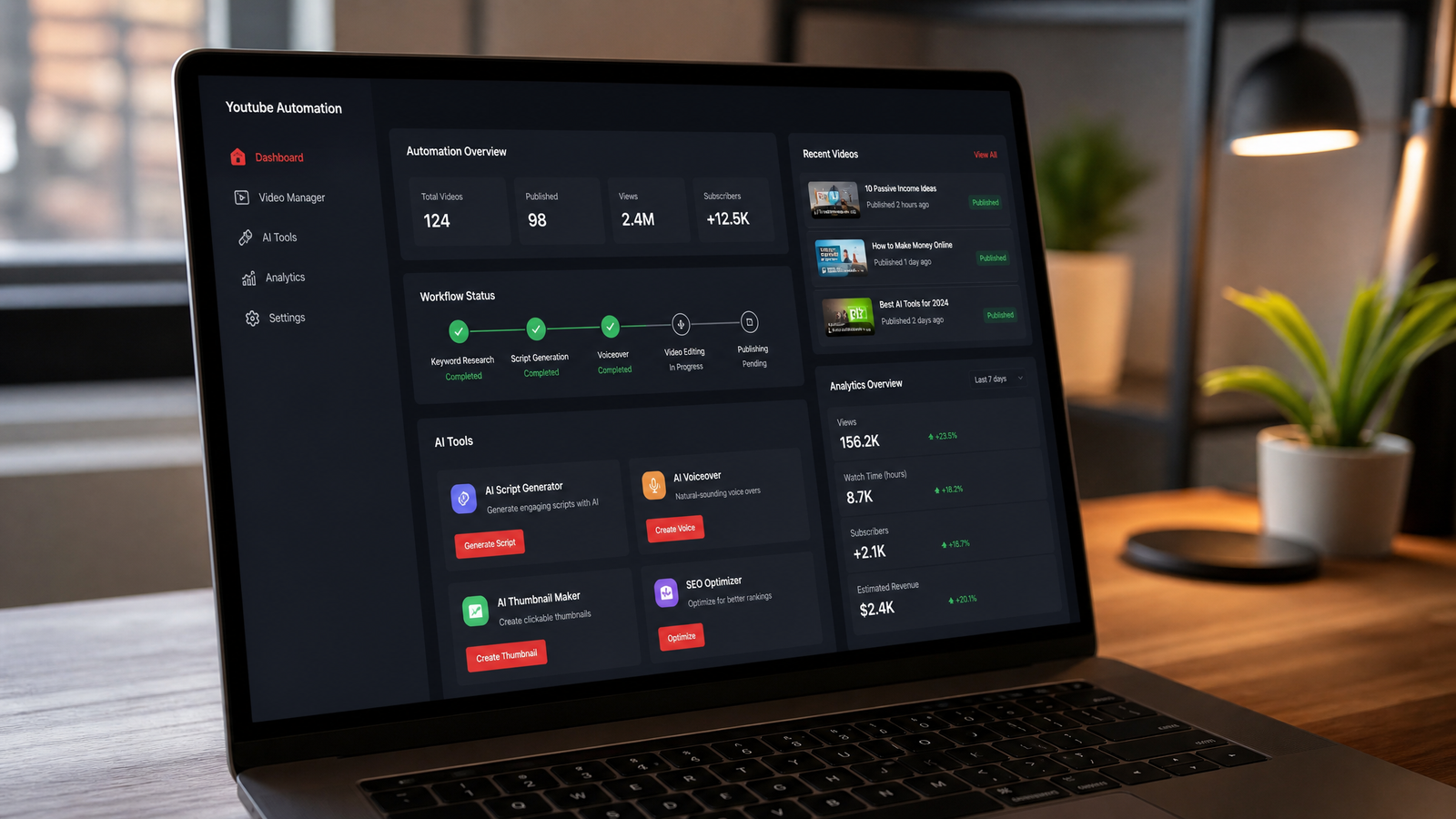
How to Start YouTube Automation — Step by Step
Here are the 7 steps. Do them in order. Do not skip Step 1 — it is the step most beginners skip, and it is the reason most channels fail.
Step 1: Pick a Niche
One niche. One audience. Do not make videos on every topic. A good niche for automation has three things: people search for it, it can be made faceless, and advertisers pay for it. Finance, tech, health, Islamic content, and cricket all work well in Pakistan. Entertainment and random facts are harder to monetize. For the full niche framework, read: Faceless YouTube Channel — Niche Selection Complete Guide.
Step 2: Find a Content Gap
Search your niche on YouTube. Find questions people ask that no good video answers yet. Check the comments of popular videos — viewers literally tell you what video they want next. Your first 10 video ideas should come from real searches, not from guessing. Use YouTube autocomplete: type your topic and see what YouTube suggests. Those suggestions are real searches by real people.
Step 3: Study Your Competition
Open the top 5 channels in your niche. For each one, note: what topics do they cover? How long are their videos? What do their thumbnails look like? What do viewers praise or complain about in the comments? Your job is not to copy them. Your job is to find what they do badly — and do it better. Maybe their videos are too long. Maybe their thumbnails are weak. Maybe they never answer the question in the title. That gap is your opening.
Step 4: Build Your Production Workflow
This is the heart of automation. Set up a repeatable process:
- Script: Write the script first — every time. A 8–10 minute video needs roughly 1,000–1,300 words. Use ChatGPT to draft, then edit it in your own words.
- Voiceover: Record your own voice on your phone, or use ElevenLabs. Keep it clear and natural.
- Edit: Use CapCut. Add stock footage, simple animations, and text on screen. Keep the pace fast — cut every boring second.
- Thumbnail: Make it in Canva. One clear image, 3–5 words, high contrast. The thumbnail is what gets the click.
- Title & SEO: Put the main keyword in the title. Write the first 2 lines of the description for the viewer, not for the algorithm.
- Upload: Upload on a fixed schedule — for example, every Tuesday and Friday. Consistency builds the habit and the data.
Do this same process for every video. After 5 videos, it becomes fast. After 10 videos, it becomes automatic. That is real automation.
Step 5: Set Up the Channel Like a Business
Treat your channel as a business from day one:
- Channel name: short, clear, related to your niche.
- About section: one paragraph — who the channel is for and what they will learn.
- Playlists: group your videos by topic so viewers watch more than one.
- Branding: one logo, one colour style, one thumbnail style. Viewers should recognize your videos instantly.
Step 6: Upload Consistently
Upload at least 2 videos per week. This is the minimum that gives YouTube enough data to understand your channel and find your audience. Do not upload 10 videos in one week and then disappear for a month. YouTube rewards steady channels, not bursts.
Step 7: Improve Every Video with Analytics
After every video, open YouTube Studio and check three numbers:
- Impressions: how many times YouTube showed your thumbnail. Low impressions = topic problem.
- CTR (click-through rate): how many people clicked. Low CTR = thumbnail or title problem.
- Retention: how long people watched. Low retention = content problem.
Fix one thing per video. Better thumbnail this time. Better hook next time. Small improvements, video after video — that is how small channels become big ones. For the full growth system, read: How to Grow YouTube Channel Organically in Pakistan.
Best Niches for YouTube Automation in Pakistan
Not all niches pay the same. Here are the best options for a Pakistani creator, with honest RPM logic:
| Niche | Why it works | RPM level |
|---|---|---|
| Finance & money | Advertisers pay a lot; viewers are serious | High |
| Tech & mobile reviews | Big audience, good sponsors | High |
| Health & fitness | Always in demand, wide audience | Medium–High |
| Islamic content | Loyal audience, huge search volume in Urdu | Medium |
| Cricket & sports | Massive Pakistani audience, viral potential | Medium |
| Urdu storytelling | Low competition, easy to make faceless | Medium |
| Cooking (Urdu) | Huge audience, especially women viewers | Medium |
| Education & study tips | Students search every day | Medium |
| Facts & history | Easy to automate, but lower RPM | Low–Medium |
| Entertainment & memes | Fast views, but lowest RPM and hardest to monetize | Low |
Our advice: pick a niche you can make 30 videos about without getting bored. Passion matters more than RPM at the start — because you will quit a boring niche before you ever earn from it. If you are a complete beginner, start here: Learn YouTube from Beginner.
Your 18-Day Action Plan
Knowledge without action is useless. Here is your day-by-day plan. Follow it exactly.
| Day | Work |
|---|---|
| Day 1 | Pick your niche. Write down why you chose it. |
| Day 2 | Study 5 competitor channels. Note their best and worst videos. |
| Day 3 | Write 10 video ideas from real YouTube searches. |
| Day 4 | Set up your channel: name, About section, logo, banner. |
| Day 5 | Write your first script (1,000+ words). Use ChatGPT to draft, edit in your own words. |
| Day 6 | Record the voiceover. Edit video 1 in CapCut. |
| Day 7 | Make the thumbnail in Canva. Upload video 1 with SEO title + description. |
| Day 8 | Write script 2. Start building your template (intro, outro, text style). |
| Day 9 | Record + edit video 2. Upload it. |
| Day 10 | Study your first video’s analytics: impressions, CTR, retention. |
| Day 11 | Write scripts 3 and 4 in one sitting (batching saves time). |
| Day 12 | Record + edit video 3. Upload it. |
| Day 13 | Make 2 Shorts from your long videos. Upload one Short. |
| Day 14 | Record + edit video 4. Upload it. |
| Day 15 | Improve your workflow: save your CapCut template, your Canva thumbnail template, your description template. |
| Day 16 | Upload video 5. Share it in one relevant community (no spam). |
| Day 17 | Review all analytics. Which video worked best — and why? Plan your next 10 videos around what worked. |
| Day 18 | Upload video 6. Celebrate: you now have a working automation system — and a real channel. |
After 18 days, you will have 6 videos, one clear niche, templates for every step, and real data about what works. That is more than most people achieve in 6 months of “planning.”
CTA — YouTube 18 Days Formula. Want these 18 days taught step by step — in simple language, with support when you get stuck? The YouTube 18 Days Formula is exactly this plan as a course: 13 modules, 9+ hours of training, lifetime access, WhatsApp support (0314-5963891), for PKR 3,900 (was PKR 5,800). You get the system, the templates, and the support — but your result depends on your hard work and consistency. There is no promise of guaranteed income or guaranteed views. Join now: Junaidyt.com — YouTube Growth Program
If you want a deeper comparison of automation courses in Pakistan, read: YouTube Automation Course in Pakistan.
YouTube Monetization Requirements — and the 2027 Change
To earn from ads, you must join the YouTube Partner Program (YPP). Here are the requirements — and an important change coming soon.
| Requirement | Now (until 31 Jan 2027) | From 1 Feb 2027 |
|---|---|---|
| Subscribers | 1,000 subscribers | 1,000 subscribers (no change) |
| Watch hours | 4,000 watch hours in 12 months | 8,000 watch hours in 365 days |
| OR Shorts views | 10 million Shorts views in 90 days | 20 million Shorts views in 90 days |
| AdSense account | Required | Required |
| 2-step verification | Required | Required |
| No active strike | Required | Required |
| Country eligibility | Pakistan is eligible | Pakistan is eligible |
Warning — start now, the bar doubles on 1 Feb 2027. YouTube announced in August 2026 that from 1 February 2027, new applicants will need 8,000 watch hours (was 4,000) or 20 million Shorts views (was 10 million). The 1,000-subscriber requirement stays the same.
Important: creators who are already in the Partner Program are NOT affected. The new rules apply only to new applicants from 1 Feb 2027. But if you have not joined yet, your target is now 8,000 hours — so every month you wait makes the journey longer.
That is exactly why starting now matters more than ever. A channel that starts today has months to build toward the old target. A channel that starts in February must hit double the number.
Also note: from 1 Feb 2027, channels earning from Shorts must maintain 10 million Shorts views in every rolling 90-day window to keep earning from the Shorts pool.
After you meet the requirements, you apply from YouTube Studio. YouTube reviews your channel — is your content original, are you following the policies — and then ads start to run on your videos.
7 Mistakes That Can Get Your Channel Banned
Automation is powerful — and dangerous if you do it wrong. Avoid these 7 mistakes:
- Buying views or subscribers: This is against YouTube policy. Fake views can give your channel a strike, your monetization can be rejected, and your channel can be terminated. Always grow with real views.
- Using bots for likes, comments, or engagement: Bots violate YouTube’s fake-engagement policy. Some courses even teach “engagement automation” with bots — never do this. It is the fastest way to lose your channel.
- Uploading reused content: Downloading other people’s videos and uploading them again will get your monetization rejected. Add your own value — your own script, your own voice, your own editing.
- Mass-producing AI videos with no value: Uploading 50 AI videos a day with the same template, no research, and no real script is low-value content. YouTube calls this “inauthentic content” and can demonetize it.
- Clickbait titles that lie: A title that promises what the video does not deliver kills your retention — and when retention drops, YouTube stops showing your video.
- Changing your niche every week: One week finance, next week gaming, next week cooking. YouTube gets confused about who to show your videos to, and your audience leaves.
- Giving up after 10 videos: The first 10–20 videos of almost every channel get low views. That is normal. The creators who reach monetization are the ones who did not stop.
FAQs: YouTube Automation in Pakistan
1. What is YouTube automation?
YouTube automation means building a repeatable system for your channel — script, voiceover, editing, thumbnail, SEO, and upload — using tools or a small team to handle parts of it, so you can publish consistently without doing every task by hand each time.
2. Is YouTube automation legal in Pakistan?
Yes. YouTube does not ban automation. It bans cheating — buying views, using bots, uploading reused content, and mass-producing low-value AI videos. If you follow YouTube’s policies and add real value, automation is fully allowed in Pakistan and everywhere else.
3. How much does YouTube automation cost in Pakistan?
You can start with Rs 0 using free tools: ChatGPT (free), CapCut (free), Canva (free), and YouTube Studio (free). Paid tools like ElevenLabs cost about PKR 1,700 per month. Hiring freelancers costs roughly PKR 2,300–10,000 per video. Start free, and spend only after you earn.
4. Can I do YouTube automation from mobile only?
Yes. Many Pakistani creators start with just a phone. You can write scripts in ChatGPT, edit in CapCut mobile, make thumbnails in Canva mobile, and upload from the YouTube Studio app. A laptop helps later, but it is not required to start.
5. Does YouTube pay for AI videos?
Yes — if the video follows the policies. YouTube pays for views on monetized videos, whether the voiceover is human or AI. But the video must have original value: your own script, your own research, your own editing. Pure AI output with no human input can be rejected for monetization as low-value or inauthentic content.
6. How much can I earn from YouTube automation in Pakistan?
It depends on your views, niche, and audience country. For a Pakistani audience, RPM is usually $0.20–$1.50 per 1,000 views — about PKR 56–420. So 100,000 views earn roughly PKR 5,600–42,000 from ads. US or UK audiences pay 10–20x more. There is no fixed salary and no guarantee.
7. How long does it take to monetize an automation channel?
It depends on your niche, consistency, and video quality. Most channels take 3–12 months to reach 1,000 subscribers and the watch-hour target. And remember: from 1 Feb 2027, new applicants need 8,000 watch hours (was 4,000), so starting now gives you more time.
8. Do I need to show my face for YouTube automation?
No. Faceless channels are one of the most popular forms of automation. You can use stock footage, animations, screen recordings, and AI voiceover. Monetization does not require showing your face — it requires 1,000 subscribers and the watch-hour target.
9. What tools do I need for YouTube automation?
For beginners: ChatGPT (scripts), CapCut (editing), Canva (thumbnails), YouTube Studio (analytics and uploads), and your phone. That is the complete starter stack — all free. Add ElevenLabs for AI voiceover and vidIQ or TubeBuddy for keyword research when you are ready.
10. Is YouTube automation worth it in 2026?
Yes — if you treat it as a real system and not a get-rich-quick scheme. Automation saves time, faceless channels remove the camera barrier, and the demand for YouTube content in Pakistan keeps growing. But it only works with consistency: at least 2 videos per week, improving one thing every time, for months — not days.
Disclaimer: The information in this guide is for general learning. YouTube policies, monetization requirements, and RPM can change over time — including the February 2027 Partner Program changes described above — so always check YouTube’s official policies. No course or guide can give you guaranteed views or guaranteed income — success depends on your hard work, consistency, and content quality.
One Response